
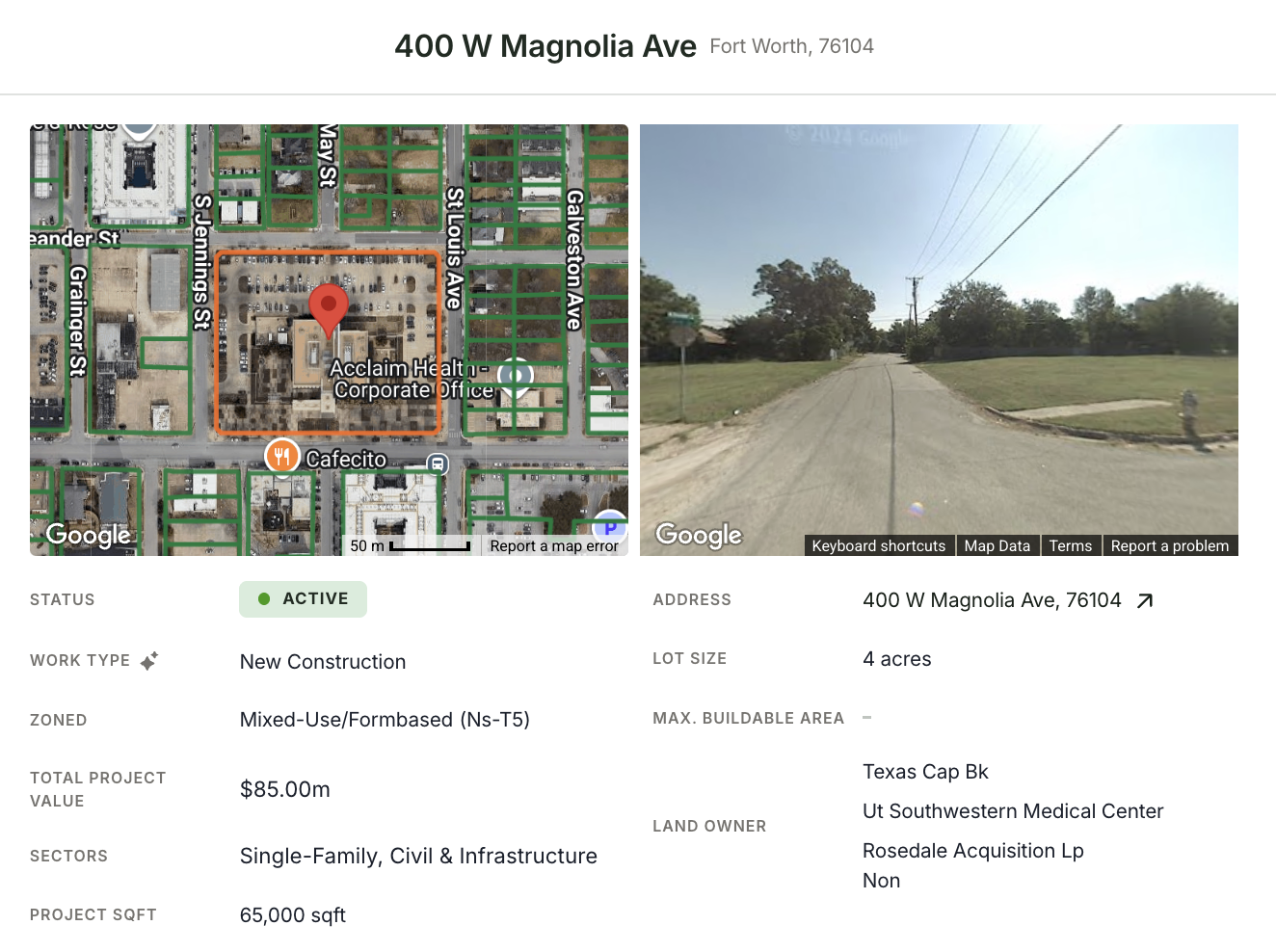

By the time a project hits public bid boards, you’re already behind. The key players are often in place, and your margins get squeezed by the competition. The real advantage lies in spotting opportunities months earlier, during the quiet planning and entitlement phases. That’s exactly what happened with UT Southwestern’s new $85 million Radiation Oncology Center at 400 W Magnolia Ave, Fort Worth. While others wait for official announcements, our platform flagged the initial entitlement documents, signaling a major healthcare project was underway long before it became common knowledge. This is your guide to understanding this project and how early intelligence creates real business opportunities.
Project Type: New Construction
Address: 400 W Magnolia Ave, Fort Worth, TX 76104
Total Project Value: $85,000,000
Project Size: 65,000 SF
Sector: Healthcare / Institutional
Stage: Pre-Construction (Procurement Open)
Detected by: Mercator.ai
Early Discovery: How Mercator.ai Found It First
When UT Southwestern filed early entitlement documents for its new Radiation Oncology Center in Fort Worth, Mercator.ai surfaced the project days after submission.
Mercator.ai uses AI-driven construction intelligence to scan and connect public filings, permits, environmental reviews, and stakeholder data—giving builders and suppliers an information advantage months before bid lists or trade publications catch up.
For users tracking healthcare and institutional projects, Mercator.ai is where new opportunities first appear.
Project Overview
UT Southwestern Medical Center is investing $85 million to construct a two-story, 65,000-square-foot radiation oncology facility at 400 W Magnolia Ave, directly expanding its Moncrief Cancer Institute campus.
The program includes:
- Five linear accelerator (LINAC) vaults
- Dedicated MRI / MR SIM suites
- High-Dose Rate (HDR) therapy rooms
- PET-CT and CT simulation suites
- Administrative offices and clinical support areas
- A new structured parking garage
As of October 2025, the project’s environmental review and TDLR accessibility registration are complete, but no general contractor has been listed—a signal, according to Mercator.ai, that the procurement window remains open.
About the Moncrief Cancer Institute
The new facility is an extension of the existing Moncrief Cancer Institute, a respected nonprofit at the heart of Fort Worth's cancer care community. As a community-based cancer prevention and support center, its mission is to serve the social, emotional, and physical needs of individuals with cancer and their families. For contractors and suppliers, this context is key. This project isn't just a building; it's a significant investment by UT Southwestern to expand a facility centered on patient well-being. Understanding the institute's mission helps clarify the high standards and attention to detail that will be expected from every team involved in bringing this vision to life.
Services and Programs at the Institute
The Moncrief Cancer Institute takes a comprehensive approach to care, focusing on preventing cancer, detecting it early, and supporting people through every step of their journey. The institute provides a wide range of services, from advanced medical expertise to essential emotional and physical support programs. The new Radiation Oncology Center will directly enhance these offerings by housing state-of-the-art treatment technologies, including linear accelerators and PET-CT simulation suites. This expansion will allow the institute to provide more integrated and advanced therapeutic options, ensuring patients receive holistic care that addresses both their medical and personal needs under one roof.
Institute Contact Information
For teams planning site visits or needing a point of reference for the existing campus, the institute is centrally located in Fort Worth’s medical district. The center's address is 400 W. Magnolia Avenue, Fort Worth, Texas 76104, which is the same address listed on the initial project filings for the new Radiation Oncology Center. This confirms the expansion is happening on the current campus grounds. The local phone number for the Fort Worth location is 817-288-9800. Having this information handy is useful for logistical planning and for understanding the layout of the existing facilities and the surrounding area before work begins.
Recent Activity Timeline
- Sept 26 2025: Project first detected by Mercator.ai
- Sept 29 2025: Environmental Review – Approved
- Sept 30 2025: TDLR Accessibility Registration – Filed (TABS2026002222)
- Oct 6 2025: Urban Forestry Review – Not Required
For subscribers, Mercator.ai automatically generates real-time notifications when statuses like these change—helping users track momentum and time outreach precisely.
How Mercator.ai Works
Mercator.ai aggregates and enriches data from thousands of municipal sources, design filings, and project submissions. Using AI, it links:
- Projects → active and historic records across jurisdictions
- Companies → their roles (owner, architect, civil engineer, GC)
- Contacts → emails and direct dials from official documents
This allows construction firms, manufacturers, and suppliers to:
- Identify projects in early design or procurement
- Find verified decision-makers for target accounts
- Receive AI-curated intel as projects progress
In short, Mercator.ai is the command center for pre-bid market intelligence—turning scattered public data into actionable sales pipelines.
Construction and Bidding Insight
UT Southwestern typically procures large capital projects through Construction Manager at Risk (CMAR) or hard-bid shortlists.
Given the project’s radiation shielding and vibration-sensitive imaging, contractors with strong healthcare experience will have a competitive advantage.
Specialty Scopes Include:
- Radiation shielding installation and QA/QC
- Heavy MEP coordination for LINAC and PET systems
- Structural slab and vibration control
- Cleanroom-grade finishes and infection control detailing
By monitoring the project on Mercator.ai, GCs and subcontractors can be notified as soon as bid packages or construction documents are released.
Market Context: Why It Matters
Fort Worth’s Medical District is one of the fastest-growing healthcare corridors in Texas. With UT Southwestern’s new oncology facility joining major neighbors like Cook Children’s and Texas Health Harris Methodist, construction activity is accelerating.
For builders and suppliers specializing in medical infrastructure, Mercator.ai is the go-to platform for tracking where institutional capital is flowing next—from design to entitlement to bid.
How Builders Use Mercator.ai
Mercator.ai customers—ranging from top 100 ENR contractors to regional subcontractors—use the platform to:
- Discover Projects First: Detect new developments before public bid notices are issued.
- Map Relationships: See which architects and engineers recur across owner portfolios.
- Prioritize Outreach: Use AI signals to score projects based on stage, budget, and probability of award.
- Automate Follow-Up: Save companies and projects to custom groups for real-time alerts.
By embedding Mercator.ai into their business-development stack, firms reduce manual research time and increase hit rates on early-stage work.
Opportunities for Construction Professionals
If you’re a GC, MEP contractor, or supplier with healthcare credentials, this is the moment to:
- Contact UT Southwestern Moncrief to confirm procurement method and timeline.
- Reach out to HKS Fort Worth to offer constructability input.
- Save the project on Mercator.ai to receive updates as it moves from procurement to construction.
- Follow UT Southwestern Medical Center within the platform to discover related clinical expansions across Texas.
Every interaction—down to a phone number or email listed in a filing—is sourced and verified by Mercator.ai’s AI-driven data pipeline.
About Mercator.ai
Track This Project
Mercator.ai is the leading AI platform for construction intelligence, built for contractors, suppliers, and developers who want to win work earlier. By aggregating permit filings, zoning documents, entitlements, and ownership data, it transforms fragmented public records into a real-time map of the built environment.
Users leverage Mercator to:
- Track new projects before bid stage
- Uncover verified contacts and companies
- Monitor competitor activity and regional trends
- Automate lead generation and account targeting
Book a demo, follow UT Southwestern as an owner, and receive alerts as new projects break ground in Fort Worth and across Texas.
Learn more at Mercator.ai — the fastest way to find projects before your competition does.
Frequently Asked Questions
Why is finding a project this early so important? When a project appears on a public bid board, the key relationships have often already been formed and the competition is at its peak. Finding an opportunity during the entitlement or early planning phase gives you a significant head start. It allows you to connect with owners and architects, offer input, and build trust long before the bidding process squeezes your margins.
This project was detected months ago. Is it too late to get involved? Not at all. The key signal here is that a general contractor has not yet been publicly listed, which means the procurement window is likely still open. This is the ideal time to reach out to the owner and design team to understand their selection process and position your company as a valuable partner, especially if you have specialized healthcare construction experience.
How is this different from just using a standard bid board? Think of it as the difference between joining a conversation early and showing up after all the major decisions have been made. Bid boards list projects when they are ready for pricing, which is a late-stage, highly competitive part of the process. Our platform is designed to show you projects when they are just ideas or filings, giving you the upstream intelligence needed to build relationships and influence outcomes.
What kind of information do you provide besides the project's address and value? We connect the dots between the project, the people, and the companies involved. Our platform links the project to the owner, architect, and engineers by pulling their information from official documents. This means you get verified contact details and can see their past project history, helping you understand their network and find the best way to start a conversation.
This example is a large healthcare project. Does your platform work for other types of construction? Absolutely. While this oncology center is a great example of an institutional project, our AI-driven process works the same way across all commercial construction sectors. We track the same early signals—like land sales, zoning changes, and design filings—for retail, multifamily, industrial, and office projects, giving you a similar advantage no matter your specialty.
Key Takeaways
- Find Projects Before the Competition: By the time a project hits a public bid board, you're already playing catch-up. The real advantage comes from tracking early-stage documents like permits and zoning applications to identify opportunities months in advance.
- Use Early Intel to Build Relationships: Knowing about a project early allows you to connect with owners and architects before procurement begins. This gives you the chance to offer valuable input, understand their needs, and position your company as the ideal partner, not just another bidder.
- Connect the Dots with AI-Powered Data: Manually tracking public records is inefficient. An AI-driven platform automates this process by linking projects to the specific companies and decision-makers involved, giving you a clear, actionable roadmap for your business development efforts.
Related Articles



AI-powered business development for the construction industry
Schedule a time to discuss your use case and walk through a custom demo of the platform.